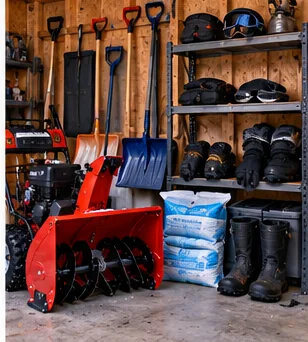
Products and configurations to compare
21-inch single-stage snow blower
Main budget item.
Best when: paved residential driveway
Watch for: deep/plow-packed snow may justify two-stage
Pusher + combo shovel pair
Always-ready backup.
Best when: steps and light storms
Watch for: requires physical effort
Ice cleats + spreader + deicer bin
Prevents blower-only mindset.
Best when: freeze/thaw creates slick surfaces
Watch for: deicer chemistry must match property
Allocate around the driveway
Long steep properties may need a more expensive machine and less accessory spend.
Do not skip manual tools
Machines cannot finish steps, around parked cars or tight corners.
Traction protects the operator
Cleats can be more important than upgrading from one shovel brand to another.
Storage counts
A covered dry zone keeps the system ready.
Buy consumables before storms
Ice melt and warmers disappear from shelves first.
Snow-blower sizing is about snow type and driveway geometry
Clearing width gets the headline, but dense end-of-driveway plow berms, wet snow, slope and throwing direction are what separate an easy machine from a frustrating one. A 21-inch single-stage machine is excellent for many paved driveways because it is compact and fast. Long gravel lanes, deep drifts and repeated plow berms can justify a larger two-stage machine.
Battery machines remove fuel, carburetor and pull-start maintenance, while gasoline still offers fast refueling and proven cold-weather runtime. Battery platform ownership matters: if you already own EGO batteries, an EGO snow blower costs less in practical terms than starting a second battery ecosystem.
Runtime claims are conditional
Snow depth, density, auger speed, throwing distance, temperature and battery age all change how much driveway one charge clears. Manufacturer “up to” driveway claims are useful comparison points, not guarantees. Keep spare batteries warm indoors until use and follow the battery maker's cold-weather guidance.
Before checkout
- Tool matches typical snow depth and whether snow is wet or powdery
- Driveway/sidewalk surface is compatible with scraper or blade material
- Battery platform and cold-weather charging/storage are understood
- Replacement wear parts or shear pins are available
- Roof tools can be used safely from the ground
- Deicer chemistry is compatible with pavement, pets and landscaping
- Traction cleats fit the exact footwear securely
- Heated gear fits without reducing circulation
- Vehicle kit remains accessible under luggage
- Storage plan allows wet equipment to dry before covering
Buy before the forecast, not during it
Snow equipment is unusual because regional demand spikes at exactly the same moment. The week a major storm appears in the forecast is when shovel racks empty, ice melt gets rationed, replacement shear pins disappear and the most popular blower models sell out. Preseason buying is not only convenient; it lets you choose the right product instead of whatever remains on the shelf.
Use a short inventory at the start of autumn: primary clearing tool, manual backup, ice control, personal traction, vehicle visibility/emergency gear and one storage location. Replace worn scraper edges and dead batteries before they become storm-day failures.
Test the system once before snow
Start the blower or install its charged batteries, unfold the roof rake, fit the cleats over the boots you will actually wear, test the spreader gate and open the car emergency bin. Practice tire chains if your travel requires them. The first time to discover a missing pin, dead charger or wrong cleat size is not at 5 a.m. in a storm.
After each event, dry gear before storage and restock consumables. Winter readiness is less about owning the most equipment than making sure the small set you rely on is ready every time.
Frequently asked questions
Can $1,000 buy a two-stage setup?
Sometimes used/value models, but quality new two-stage packages often consume most or all of the budget.
Battery or gas?
Choose around platform ownership, driveway length and maintenance preference.
Need roof rake too?
Only if roof/eave snow load or ice-dam management warrants one.
Best first accessory?
A good shovel and traction cleats.
Current product/source checks
- EGO POWER+ 2026 catalog — SNT2112 current snow-blower specs
- Toro Power Clear 721 E — current product/parts specifications
- Yaktrax Pro traction device — current official specs
Affiliate disclosure: SnowSupplies.co may earn from qualifying purchases through Amazon Associates and eBay Partner Network at no extra cost to you. Amazon links use scouttheory-20; eBay links use campaign 5339137014.