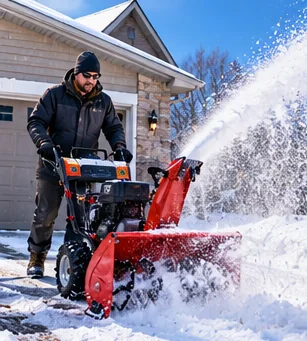
Use a three-prong, grounded cord that is marked for outdoor use, as short as your setup allows and heavy enough for the length. A smaller gauge number means a thicker wire, and longer runs need thicker wire. Your snow blower manual names the cord it wants, so use that first; if it is silent or you are unsure, step up to the next heavier gauge, plug into a ground-fault protected outlet and replace any cord with damaged insulation.
Start with the manual, not the cord aisle
Electric start on a gas machine and a fully corded electric machine both rely on a household outlet, but they draw different loads, so the cord depends on your model. The operator's manual states what it needs. Two Yardman and Yard Machines manuals for corded electric snow throwers that we read both call for a three-wire outdoor extension cord with a three-prong grounding plug and a grounded outlet; for a unit drawing 8.5 amps, one lists 16 AWG up to 50 feet and 14 AWG for 100 and 150 feet, and says to use the next heavier gauge if unsure.
Treat that as one maker's worked example, not a rule for your machine. A gas blower's starter motor has its own specification, and only your manual covers it. If the manual is missing, search your model number; the snow blower manuals page and the model number post help with that.
Gauge and length work together
Wire gauge is printed on the cord jacket. Lower numbers are thicker, and thicker wire carries more current over distance without heating. For the same gauge, a longer cord carries less safely: the Electrical Safety Foundation International (ESFI) length tables show, for example, 14 gauge handling 14 to 15 amps at 25 to 50 feet but only 1 to 7 amps at 150 feet.
The practical result is simple. Use the shortest cord that reaches, move the machine rather than add a second cord, and avoid joining two cords unless your manual allows it. If you must go long, buy heavier wire, not a thinner cord and hope.
| Check | What to look for | Why |
|---|---|---|
| Outdoor marking | Cord marked for outdoor use | Indoor cords are not built for wet snow and cold |
| Plug and receptacle | Three prongs, ground pin intact | Grounding protects against shock |
| Gauge | Heavier for longer runs; match or exceed the manual | Thin wire overheats under load |
| Length | Shortest that reaches | Longer cords lose capacity |
| Testing lab mark | Listed by a recognized lab | Independent testing of the cord |
Outdoor marking, grounding and listing
Both ESFI and the U.S. Consumer Product Safety Commission (CPSC) say to use a cord outdoors only if it is marked for outdoor use. ESFI lists "W" as the outdoor designation. Both also say to buy cords listed by a recognized testing laboratory such as UL, Intertek (ETL) or CSA. A cord with a polarized or three-prong plug is the baseline; ESFI warns never to cut off the ground pin or force a three-prong plug into a two-slot outlet.
The CPSC also says to inspect the whole cord for worn plugs, sockets or insulation and replace any damaged cord, rather than tape it. A cord that feels hot in use may be overloaded, and a damaged cord is not worth saving.
Plug into protected power
The Yardman manual says the circuit or outlet should have ground-fault (GFCI) protection and recommends receptacles with built-in GFCI. Many garage and outdoor outlets are already protected. If yours is not, a licensed electrician can add protection; do not rewire it yourself. Test a GFCI with its built-in button as the device's instructions say.
Wet snow, slush and meltwater are exactly the conditions where a cord connection fails. Keep the plug-to-cord connection off the ground and out of puddles if you can, and avoid running cords through standing water or snow, which ESFI cautions against.
Cold weather and cord handling
Cold makes jackets stiff and less forgiving. Uncoil a cord fully before you use it, rather than dragging it off a reel, and check the jacket for cracks or flat spots. Look at the cord packaging for any stated low-temperature flexibility rating; we have not verified one for any particular cord, so do not assume a cord is cold-rated.
When you connect, follow the manual's order. The Yardman manual says to secure the cord to the machine, make sure the switch is off, and only then plug into the wall. It also says to let the cord trail to the operator's side. Never carry the machine by the cord or yank the plug out. At the end of the job, unplug the cord before coiling it, and keep it away from heat, oil and sharp edges.
Unplug before you touch moving parts
A corded or electric-start machine can restart when you do not expect it. Turn the machine off, unplug the cord, and wait for the auger to stop before clearing a clog; the Yardman manual says to turn the motor off and unplug the cord before clearing the rotor. Use the clearing tool that came with the machine, not your hand. The site's clearing a clogged snow blower page walks through the steps.
For related reading, see the electric starter checks page, the electric shovel vs blower comparison and the spare parts kit.
Where to shop
These are category searches. Check the outdoor marking, gauge, length and plug style in each listing, and compare them with your manual.
Heavy-gauge outdoor extension cord
A three-prong outdoor cord in a heavier gauge for longer runs.
Best when: you plug in at a distance from the garage outlet
Watch for: check the outdoor marking, gauge and length against your manual
Portable GFCI outdoor power cord
A cord or adapter with built-in ground-fault protection for outlets that lack it.
Best when: your outdoor outlet is not GFCI-protected
Watch for: read the rating and test button instructions
Extension cord reel or wrap
A reel, hook or wrap to keep a cord untangled and off the cold floor.
Best when: you store the cord in a garage or shed
Watch for: check that the reel is rated for the cord's gauge and length
Frequently asked questions
What gauge extension cord does an electric-start snow blower need?
It depends on the machine. Use the gauge your manual lists, and choose a heavier gauge for longer runs. One corded electric snow thrower manual we read lists 16 AWG up to 50 feet and 14 AWG for 100 and 150 feet for an 8.5-amp unit.
Do I need an outdoor-rated extension cord?
Yes. The CPSC says to use a cord outdoors only if it is marked for outdoor use. Look for the outdoor marking on the jacket.
How long can the cord be?
Longer cords carry less current safely at the same gauge, so use the shortest cord that reaches and a heavier gauge for longer runs. Your manual may set a maximum length.
Should the outlet be GFCI protected?
One manufacturer manual we read says the circuit or outlet should have GFCI protection. A licensed electrician can add it where missing.
What if the cord feels warm or looks damaged?
Stop using it. A hot cord may be overloaded, and damaged insulation or a missing ground pin means the cord should be replaced, not taped.
Affiliate disclosure: SnowSupplies.co may earn from qualifying purchases through Amazon Associates and eBay Partner Network at no extra cost to you. Amazon links use scouttheory-20; eBay links use campaign 5339137014.