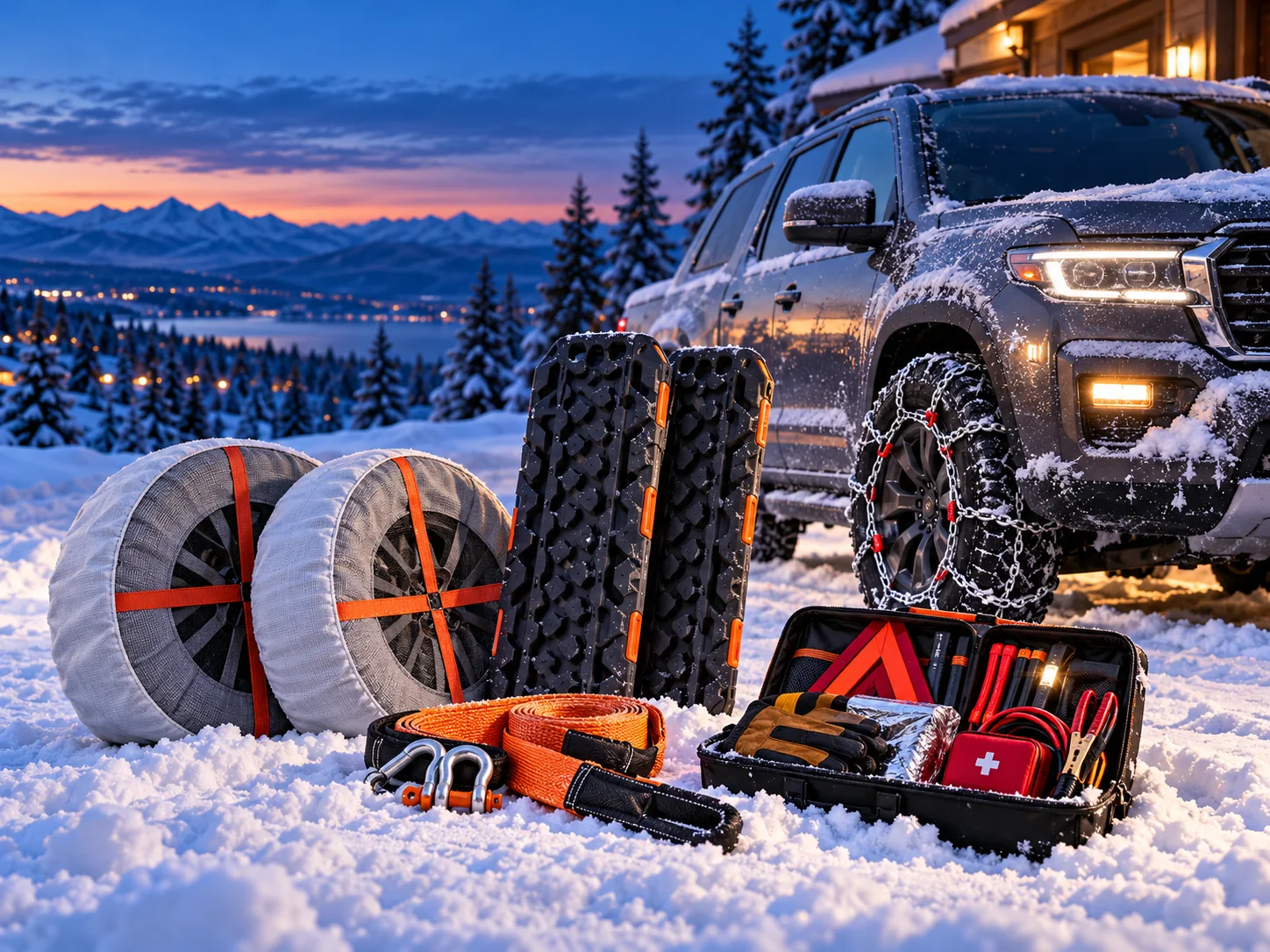
Snow socks are often enough for short, slow trips on packed snow or light ice when your vehicle's manual allows them and the road does not require chains. Chains give more bite on deep snow and thick ice and are accepted by more authorities, but they take more effort to fit and need more clearance. Neither replaces snow tires, and both are slow-speed aids.
How each works
A snow sock is a woven fabric cover that slips over the tire tread. Per the Wikipedia article on snow socks, an elastic edge holds it in place, and the fabric's contact with the road provides grip. Socks come in pairs, are sized by tire code, and mainly target cars and pickups.
A chain wraps links or cables around the tread and relies on metal biting into snow and ice. Chain designs vary: link shapes, cable styles and patterns, plus tensioners that hold the chain tight. Because they are metal, they add more clearance requirements and can cause more damage if something goes wrong.
Fit and clearance
Both are sized to your tire size, which is printed on the sidewall. Chains also need space in the wheel well; Wikipedia notes they are classed by clearance (SAE Class S, U or W), and the manual tells you which your vehicle can take. Fabric covers are thinner than chains, so they may suit tight clearance, but you still need the maker's size chart and your manual's guidance on traction devices.
Our tire chain fit worksheet shows how to gather your tire size and clearance information before you buy either, and the textile snow socks page and passenger-car chains page collect listings.
Installing them, and practicing first
Socks are generally quicker to fit than chains, since you work a fabric cover over the tread rather than wrap and tension metal. Chains involve laying out the set, wrapping the tire, securing the fastenings and tightening. Wikipedia notes chains should go on drive wheels and be retightened after a short distance.
Whichever you choose, practice once in dry daylight before you need them. A first attempt on a dark roadside in the cold is a bad time to learn. The site's tire chain safety page has the fitting basics.
Speed and distance limits
Both are slow-speed tools. Wikipedia reports that socks reduce speed to roughly 20 to 30 miles per hour depending on brand, size and vehicle class, as set out in the owner's manual, and says the same range applies to chains. Treat that as a ballpark; your device's instructions set the actual limit.
Both are meant for snow or ice, not dry pavement. Chains on dry roads can slide when braking and wear quickly, and loose or broken chains can strike the wheel well and damage the vehicle. Take either device off when the road is clear, as the instructions direct. Stop to check them after a short distance. Neither is a substitute for snow tires.
| Factor | Textile snow socks | Tire chains |
|---|---|---|
| Fitting | Fabric cover; generally quicker | Wrap, secure and tighten |
| Clearance needed | Thinner; may suit tight wheel wells | More; check SAE class and manual |
| Grip | Light snow and packed surfaces | Deep snow and ice |
| Road acceptance | Often not treated as equal to chains | Accepted more widely |
| If something goes wrong | No metal links to strike the wheel well | A loose or broken chain can strike it |
| Dry pavement | Remove when the road clears | Remove; chains slide and wear fast on dry roads |
Rules vary by road and region
This is where fabric can run into trouble. Wikipedia says socks are generally not treated as legally equivalent to chains, though some brands are individually approved, and that where chains are banned, metal-free socks may be allowed. Chain laws range from none to seasonal or conditional use to prohibition, and rules vary by state, province and locality.
That means a sock that is fine on a private street may not satisfy a chain-control checkpoint on a mountain pass. Before a trip, read the road authority's current rules for your route and check whether a specific product is listed as acceptable. Buy before you travel rather than at the pass; the buy before the forecast post explains why timing matters. This guide cites no state rule; check your own state or province's current pages.
Which to buy
- Occasional use, flat roads, tight clearance: socks, if your manual and the road rules allow
- Steep, deep-snow or mountain routes: chains, sized to your tire and clearance
- Required-chain areas: confirm what the authority accepts before you buy
- AWD or 4WD: the manual may still call for traction devices; do not assume
- Rental or borrowed car: check the rental terms for traction devices
If you may need to dig out rather than climb, see traction mats vs tire chains. For chains stored before the first storm, tire chains belong in the driveway before winter makes the case for checking them early.
Where to shop
These are category searches. Check the tire-size chart, vehicle fit and any rule-compliance claims in each listing, and compare with your manual.
Textile snow socks for your tire size
Fabric tire covers sold in pairs by tire size.
Best when: you need an occasional, easy-to-fit aid where it is permitted
Watch for: match the tire-size chart and check the speed and distance instructions
Passenger car tire chains
Link or cable chains sized to your tire and clearance.
Best when: you drive steep, deep-snow or mountain routes
Watch for: check SAE class, tire-size chart and your manual
Chain installation gloves and mat
Waterproof gloves and a kneeling mat for fitting traction devices in slush.
Best when: you want to stay dry while installing
Watch for: keep them with the chains in the trunk
Frequently asked questions
Are snow socks as good as chains?
Not in deep snow or on thick ice. Socks suit light snow and packed surfaces and are easier to fit, but chains bite harder and are accepted more widely.
Are snow socks legal where chains are required?
Not always. Socks are generally not treated as equivalent to chains, though some are individually approved. Check the road authority's current rules for your route.
Can I drive fast with snow socks or chains?
No. Both are slow-speed aids, often limited to roughly 20 to 30 mph, but your device's instructions set the actual limit.
Do snow socks fit tight wheel wells?
They may, because they are thinner than chains, but you still need the maker's size chart and your vehicle manual's guidance on traction devices.
Do I still need snow tires?
Yes, if conditions call for them. Neither socks nor chains are a substitute for snow tires.
Affiliate disclosure: SnowSupplies.co may earn from qualifying purchases through Amazon Associates and eBay Partner Network at no extra cost to you. Amazon links use scouttheory-20; eBay links use campaign 5339137014.