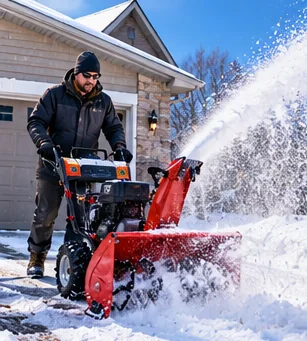
Wheeled snow blowers need tire chains only when the tires spin on packed snow, ice or a slope that the machine's tread cannot handle. Chains bite harder, but they must match the tire size and clear the frame, and they can scratch pavers, decks and concrete. Before you buy, read your manual for what it allows, measure the size printed on the tire sidewall and consider whether a tracked machine or a surface fix would be simpler.
When a wheeled blower really needs chains
Most wheeled machines clear ordinary snow without chains. The problem cases are packed snow over ice, a sloped driveway, wet snow that clumps in the tire tread and a heavy two-stage machine trying to move a full auger load on a slick surface. If the wheels spin before the auger does the work, you have a traction problem, and chains are one fix.
Before you buy, check whether the issue is the tire instead. Worn, smooth or hardened tires lose grip; replacing them may be cheaper than chains. For driveway pitch, the site's steep driveways page and the tracked versus wheeled guide cover tracked machines, which are often the longer-term answer for slick slopes.
Check the manual first
We could not find a manufacturer page that lays out chain compatibility for wheeled blowers, and compatibility differs by model. Your manual or the maker's parts page tells you whether chains are offered, which tire size they fit and whether the machine can take the extra width. If it is silent, ask a dealer for your model number rather than guessing. The model number post is a useful starting point for identifying your exact machine.
Sizing chains to the tires
Chains are sized by the tire size printed on the sidewall, and blower tire markings may look different from car tire sizes. Read the exact marking, write it down and compare it with the chain maker's size chart. Do not rely on the machine's model alone, since tires can vary. The tire chain fit worksheet shows how to record tire size and clearance before you order, although it is written around vehicle chains.
- Tire size marking copied from the sidewall
- Chain maker's chart says it fits that size
- Clearance to the frame, fender and drive housing checked by hand
- Tensioner or fastener included and in good order
- Return policy that covers a poor fit
Used sets on eBay can save money, but a bent hook, stretched link or missing tensioner turns a bargain into a hazard. Ask for photos of the cross links and fasteners, and confirm the tire size. See why snowblower parts are an eBay sweet spot for general buying checks. If you run a blower attachment on a lawn tractor, those tires are different; see the lawn tractor chains page and the snow blower tire chains page.
Fitting them safely
Shut the engine or motor off, remove the key if there is one, and wait for every moving part to stop before you touch the wheels. A hot engine or a running auger is not the time to lean in. Park on a level surface, follow the chain instructions and tighten as directed. Practice once in daylight, in a dry garage or driveway, so you learn the sequence before a storm rather than during one.
Wikipedia notes that loose chains should be refastened or removed before they can wrap an axle, that chains should be checked periodically and retightened after a short distance, and that a broken chain can slap inside the wheel well and damage the vehicle. The same logic applies to a blower: after you fit the chains, turn each wheel by hand to see that nothing catches, then go a short way and check again.
Protect the surface and the machine
Chains can damage hard surfaces; Wikipedia notes they can harm road surfaces. On a driveway that is fine. On pavers, a deck, stamped concrete or a garage floor, they can scratch or gouge. Remove them before you cross those areas, or put down a mat. Do not run them on bare, dry pavement where they will wear quickly.
After use, knock off the snow, rinse off road salt, let them dry and hang them. Rust and kinks shorten a chain's life and make the next fit harder. If a tire is flat or the chains are damaged, do not run the machine on them.
Alternatives before you buy chains
If the issue is a slick patch, clear and treat it instead: shovel the ice, add traction sand or ice melt, and see the traction sand guide. If the machine fights a hill every storm, a tracked or heavier machine may be the cleaner fix. Chains solve a narrow problem; a bad driveway slope, worn tires or a machine that is too light for the job are different problems.
Whichever route you take, keep the rest of the kit ready; the snow blower spare parts kit and the winter gear station make a good starting list.
Where to shop
These are category searches. Match the tire size printed on your blower's tires to the listing, and compare with your manual before you buy.
Snow blower tire chains for your tire size
Chains sold by tire size for wheeled machines.
Best when: your blower spins on ice or a slope
Watch for: match the sidewall marking and check clearance by hand
Lawn tractor tire chains
Chains for tractors running a front blower attachment.
Best when: you push snow with a tractor attachment
Watch for: tire sizes differ; check the chain maker's chart
Traction sand for icy driveways
Granular traction material for a slick spot without chemicals.
Best when: the problem is one icy patch, not the machine
Watch for: check coverage and storage; keep it dry
Frequently asked questions
Do snow blowers need tire chains?
Not usually. Add them only if the wheels spin on ice or a slope and your manual allows it. Worn tires or a hill may be better solved another way.
How do I find the right chain size?
Read the tire size marking on the sidewall, then match it to the chain maker's size chart. Blower tire markings may look different from car tire sizes.
Can chains damage my driveway or deck?
They can scratch or gouge hard surfaces such as pavers, decks and stamped concrete. Remove them before crossing those areas.
Is it safe to fit chains with the engine running?
No. Shut the machine off, remove the key if there is one, and wait for moving parts to stop before touching the wheels.
Are tracked snow blowers better than chains?
Often for steep or icy driveways, because the machine is built for traction, but check weight, price and your surface before you decide.
Affiliate disclosure: SnowSupplies.co may earn from qualifying purchases through Amazon Associates and eBay Partner Network at no extra cost to you. Amazon links use scouttheory-20; eBay links use campaign 5339137014.